Guides & comparisons
5-Amino-1MQ Colour: Why It Is Orange, Not White
Colour is a property of the molecule, not a grade of quality. 5-Amino-1MQ is a coloured quinolinium salt, so its cake runs yellow through rust-orange, just as GHK-Cu is blue because copper is blue. Uneven shading, pale patches and cracks come from how the cake froze and how it travelled.
In short
- 5-Amino-1MQ is normally yellow to rust-orange. White powder sold under that name is the observation that deserves a question, not the other way round.
- Colour belongs to the molecule. GHK-Cu is blue because copper is blue. Most peptides are white; these two are not peptides-as-usual.
- Pale patches, a darker crust, voids and cracks are freeze-drying and transport artefacts. They change how a cake looks, not what is in it.
- Three things are worth raising with a seller: pronounced inconsistency across one kit, colour that contradicts the compound, and anything that will not dissolve cleanly.
- Appearance can rule things out. It can never rule anything in. Identity, purity and content are measurements.
The question arrives in support inboxes in almost the same words every time. Someone has opened their first kit, they are holding a small glass vial up to the light, and something about it looks wrong: pale patches across the top, one vial darker than its neighbour, a cake that has come loose from the glass. Is this normal?
Underneath the question sits an assumption worth examining, because it is the source of most of the worry: that a correct vial is a white vial.
What colour should 5-Amino-1MQ be?
Yellow through to a deep rust-orange. That is the range across the laboratory certificates and vial photographs in our own library.
5-Amino-1MQ is sold alongside peptides, but it is not one. It is a quinolinium salt: a small aromatic molecule, and aromatic quinolinium compounds are coloured. The orange is the compound, not a contaminant, not oxidation and not age.
“Aromatic” has nothing to do with smell, incidentally. The name is a historical accident: the first compounds of this kind that chemists got their hands on happened to be the fragrant ones, and the label stuck. What it actually describes is a flat ring system whose electrons are smeared out across the whole ring instead of sitting between individual atoms. Here that means two fused six-membered rings, one of them carrying a nitrogen. Those loose electrons are also exactly why the powder is orange: they absorb part of the visible spectrum, and the colour you see is whatever is left over.
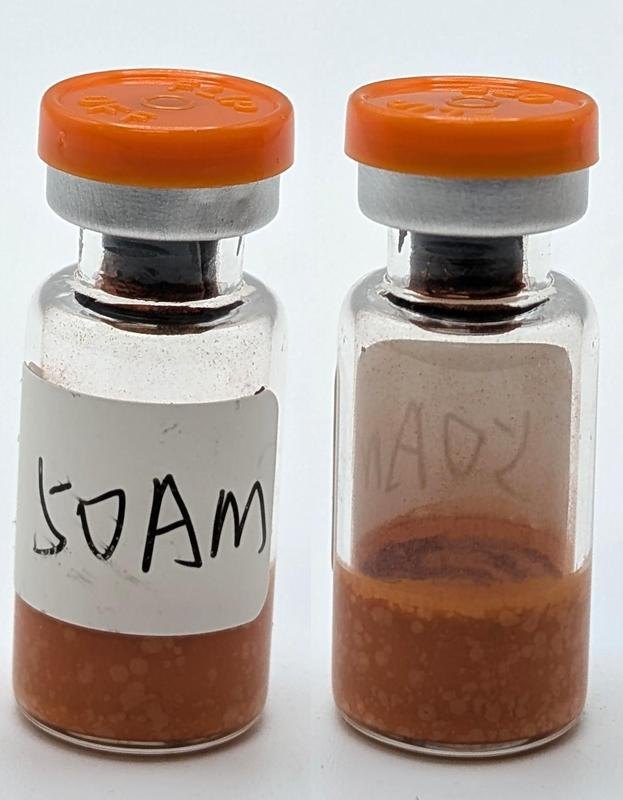
So the red flag is inverted from what most people expect. Orange is the ordinary case. White powder sold as 5-Amino-1MQ is the observation that deserves a question.
Why some compounds are coloured and most peptides are white
Most lyophilised peptides are white to off-white, so that becomes the mental default. But colour is a property of the compound, and several of the most-purchased research compounds are not white at all.
GHK-Cu is the clearest case. It is a copper complex, and copper complexes are blue. The GHK-Cu vials photographed on certificates in our library are a distinct periwinkle blue powder. A vial of GHK-Cu that arrived white would be the thing to ask about, because the blue is the copper doing what copper does.
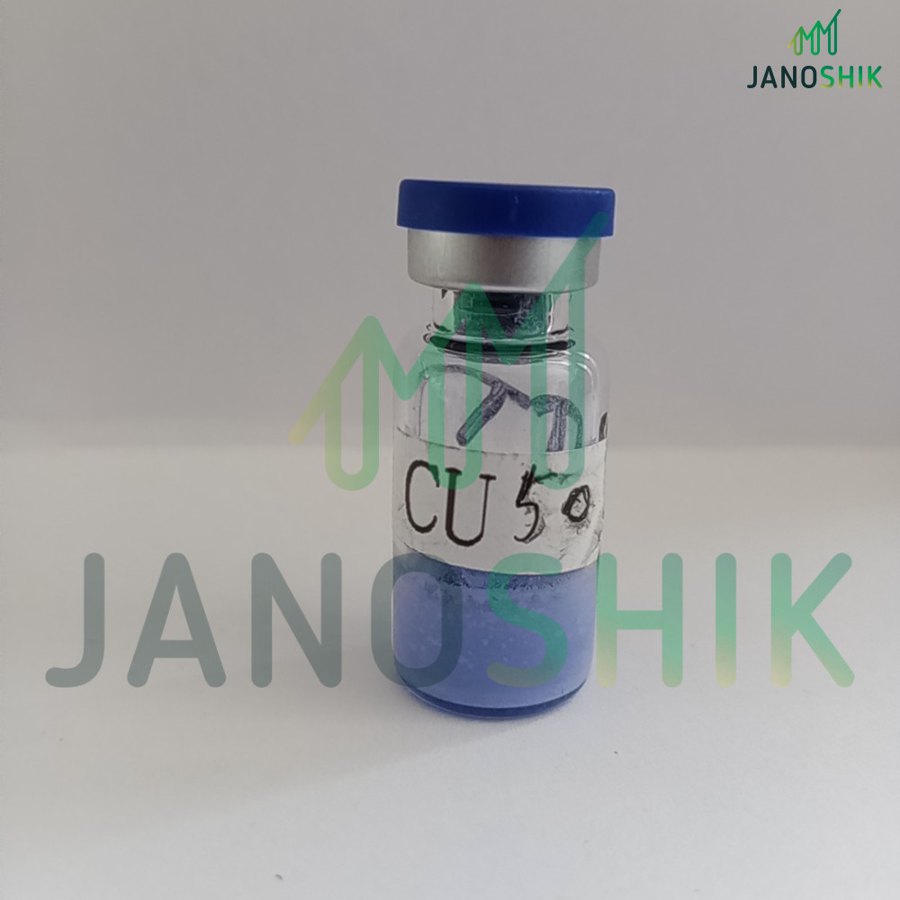
The useful rule is not “peptides are white”. It is: find out what colour that specific compound is, then compare.
Why is the lyophilised cake patchy, cracked or uneven?
The second half of the question is usually not about colour but about texture: pale patches, a darker crust on top, a cake that has broken up or lifted away from the glass.
Freeze-drying produces a solid by freezing a solution and then pulling the water off under vacuum. How that solid ends up looking depends on conditions that vary vial to vial:
- Cooling rate. How fast the solution froze sets how densely the cake grows together. Denser regions read darker, looser regions lighter.
- Position in the vial. Material against the glass wall freezes on a different schedule from material in the middle, so a single cake can be two shades at once.
- Residual moisture. How the remaining moisture distributes as it leaves changes the surface, which is where the pale patches usually come from.
- Fill volume. Larger fills, such as a 50 mg vial, tend to form bigger bubbles and voids inside the cake. Those can split during shipping, leaving a cake that looks cracked, hollow or detached from the glass.
None of that is a defect. It is a record of how one particular vial froze and how it travelled. A cake that arrives as a neat uniform disc and one that arrives in pieces can hold the same material.
When vial appearance is actually worth acting on
Appearance is weak evidence in general, but not useless. Three things are worth raising with whoever sold you the vial:
- Pronounced inconsistency across one kit. Colour is a weaker signal for this compound than for most. Because 5-Amino-1MQ is coloured to begin with, the freeze-drying effects above show up as visible differences in shade, where a white cake would hide exactly the same density and moisture variation. So expect a range across a kit, and a wider one than you would tolerate in a white powder. What still warrants a question is a kit where several vials clearly do not belong together, as opposed to a spread of shades across them. Within a single lot, that points at production rather than at the compound.
- Colour that contradicts the compound. White where the molecule is coloured, or coloured where it should be white.
- What happens in solution. Community reports describe correctly dissolving 5-Amino-1MQ as going to a clear orange that clears quickly. Cloudiness that does not resolve, floating particles, or material that will not dissolve are worth recording, whatever the powder looked like.
What vial appearance cannot tell you
This is the part that matters most, and it is short.
Appearance can rule some things out. It can never rule anything in. A correctly coloured, evenly formed, cleanly dissolving cake tells you nothing about identity, nothing about purity, and nothing about how much compound is actually in the vial. Those are measurements, and measurements come from a laboratory.
The well-documented grey-market failures make the point. When a vial sold as one compound turned out on testing to be a different compound entirely, nothing about how it looked gave that away. It took an assay.
And a certificate has its own limit, covered in What a CoA Cannot Tell You: it describes the sample that reached the laboratory, which is not the same object as the vial in your hand. Appearance sits one rung below that again.
So the honest ordering is: appearance is a first look that can prompt a question, a lot-matched certificate from a named laboratory is evidence about the material, and neither is a substitute for the other. How to read that certificate is covered in How to Read a Peptide COA, and how to tell a recycled or mismatched one from a real one in Fake, Recycled and Mismatched COAs.
Peppies publishes this guide and sells research compounds, including some discussed here, so read it with that interest in mind. The colour and cake observations come from certificates and vial photographs in our own library and from public community reports, each cited as what it is.
Research use only. Not for human or veterinary diagnostic or therapeutic use. Nothing here is medical advice, a diagnosis, a dosing instruction or a treatment claim.
Questions this guide answers
- What colour should 5-Amino-1MQ be?
- Yellow through rust-orange. 5-Amino-1MQ is not a peptide but a coloured quinolinium salt, and the colour belongs to the molecule itself. Some published vendor guidance describes it as a white or off-white cake, which does not match lab-tested material we hold certificates and vial photographs for.
- Is it normal for one vial to be darker than another in the same kit?
- Mild shading differences between vials, and within a single cake, are ordinary freeze-drying artefacts. A pronounced difference across a kit is worth raising with the seller, because it points at inconsistent production rather than at the compound.
- My cake has pale patches and has cracked loose from the glass. Is that a problem?
- Not in itself. Larger fills form bigger voids in the cake, and those can split in transit, leaving a cake that looks broken or has lifted off the wall. It changes how the cake looks, not what is in it.
- What colour is GHK-Cu powder?
- Blue. GHK-Cu is a copper complex and copper complexes are blue, so a vial of GHK-Cu that arrived white would be the one to ask about. Colour follows the chemistry of the specific compound rather than a general rule about peptides.
- Can appearance tell you whether a vial contains what the label says?
- No. Appearance rules some things out but can never establish identity, purity or how much compound is in the vial. Only a laboratory measurement on that lot does that, and even then the certificate describes the tested sample rather than the vial in your hand.